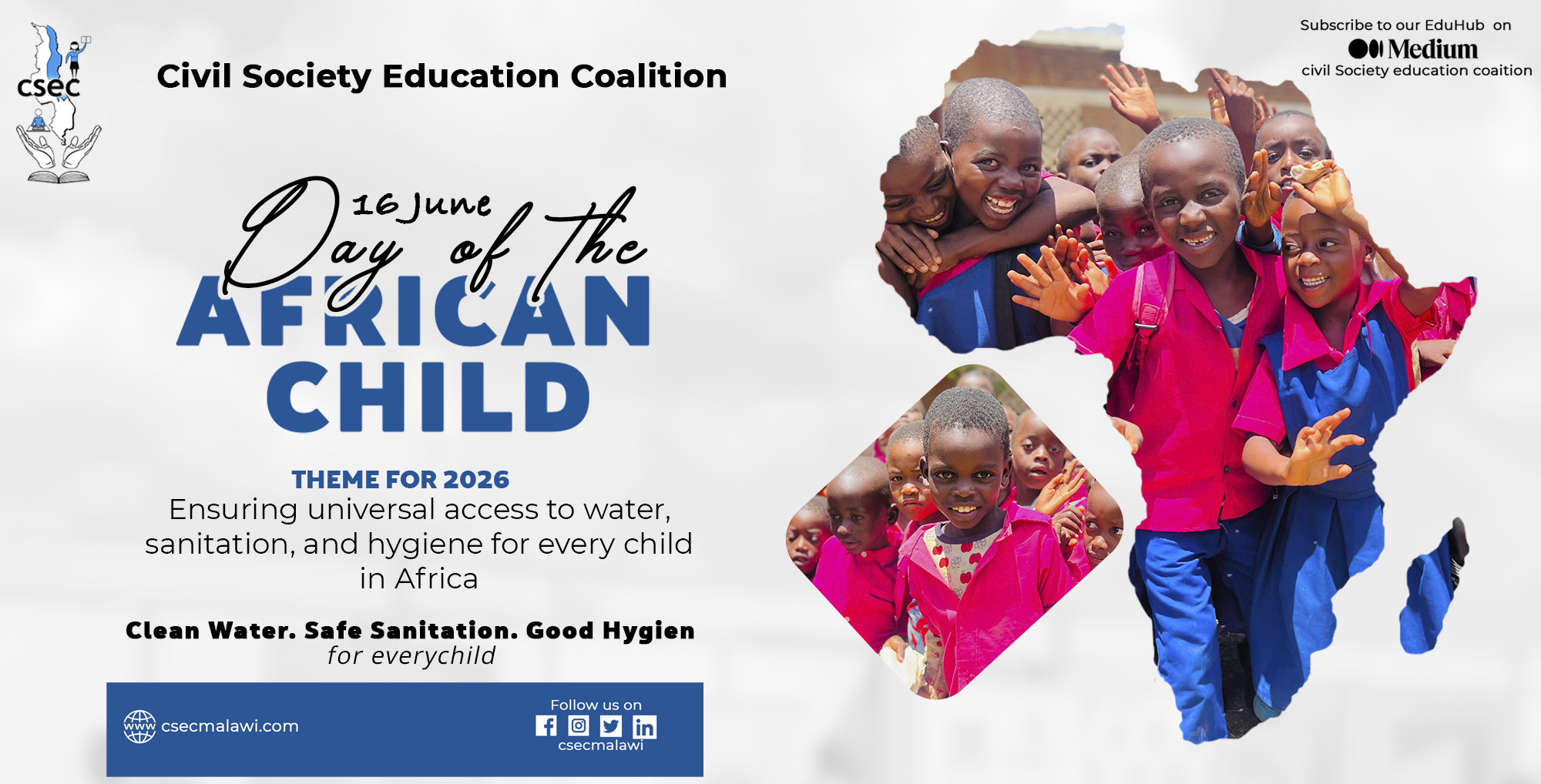
Every year on 16 June, Africa pauses to remember the courage and sacrifice of the young people who took to the streets of Soweto, South Africa, in 1976 to demand quality education and dignity. Their bravery, which led to the tragic loss of many young lives, became a powerful symbol of the ongoing struggle for children’s rights across the continent.
The Day of the African Child (DAC) was established in 1991 by the Assembly of Heads of State and Government of the former Organisation of African Unity (OAU) to honour these children and to renew commitments towards creating an Africa where every child enjoys their rights fully.
This year, the African Committee of Experts on the Rights and Welfare of the Child (ACERWC) has adopted the theme:
“Ensuring Universal Access to Water, Sanitation and Hygiene for Every Child in Africa.”
For the Civil Society Education Coalition (CSEC), this theme is a powerful reminder that quality education cannot be achieved without safe and inclusive learning environments. Access to clean water, proper sanitation facilities and hygiene services is not a privilege—it is a fundamental right that directly influences children’s ability to learn, participate and succeed in school.
Water, Sanitation and Education an inseparable connection
When a child walks long distances to fetch water before attending classes, their concentration and academic performance are affected. When schools lack safe toilets and handwashing facilities, learners are exposed to diseases that lead to absenteeism and poor educational outcomes. When adolescent girls do not have access to gender-responsive sanitation facilities and menstrual hygiene support, many miss classes or drop out altogether.
Across Africa, millions of children continue to face these realities every day.
The 2026 Day of the African Child theme recognises that water, sanitation and hygiene (WASH) are essential building blocks for the realisation of children’s rights, including the rights to health, dignity, protection and education. It calls upon governments, development partners, civil society organisations and communities to accelerate efforts towards ensuring that no child is left behind.
Despite progress made in expanding access to WASH services, significant disparities remain across the continent. Children living in rural communities, informal settlements, humanitarian settings and climate-vulnerable regions often bear the greatest burden.
For many girls, inadequate sanitation facilities compromise their safety, privacy and dignity. Children with disabilities frequently encounter inaccessible infrastructure that limits their participation in education. Climate change-induced droughts and floods continue to disrupt access to safe water sources, threatening children’s health and learning opportunities.
These challenges underscore the urgent need for investments that prioritise child-responsive and climate-resilient WASH systems.
Why This Matters for Malawi
In Malawi, the pursuit of inclusive and equitable quality education remains closely linked to the availability of adequate WASH facilities in schools and communities.
Schools that have reliable access to clean water and safe sanitation facilities experience improved attendance rates, better health outcomes and enhanced learner participation. Conversely, inadequate WASH infrastructure contributes to increased school absenteeism, heightened vulnerability to disease outbreaks and reduced educational attainment.
As a coalition committed to advocating for policies and practices that strengthen education systems, CSEC recognises that achieving Sustainable Development Goal 4 on Quality Education cannot happen in isolation from Sustainable Development Goal 6 on Clean Water and Sanitation.
A child cannot fully exercise their right to education if they are denied their right to safe drinking water and dignified sanitation.
The Day of the African Child 2026 presents an opportunity for collective reflection and action. Governments and stakeholders must strengthen efforts to ensure that children’s WASH needs are integrated into national planning and budgeting processes.
This includes:
- Investing in child-friendly WASH facilities in schools and communities;
- Ensuring that school sanitation facilities are inclusive, safe and responsive to the needs of girls and children with disabilities;
- Promoting hygiene education and handwashing practices among learners;
- Prioritising underserved and rural communities where access gaps remain significant;
- Strengthening monitoring systems to track inequalities affecting children’s access to WASH services;
- Meaningfully involving children in decisions that affect their health, education and wellbeing.
These actions are not merely development interventions; they are obligations grounded in children’s rights.
Children’s Voices Matter
The spirit of the Day of the African Child reminds us that children are not passive beneficiaries of development programmes. They are rights holders whose voices, experiences and perspectives must shape policies and solutions.
Meaningful child participation can help identify barriers that adults may overlook. Children understand the realities within their schools and communities. Their insights are essential in designing effective, sustainable and inclusive WASH interventions.
As stakeholders work towards achieving universal access to water, sanitation and hygiene, children themselves must remain at the centre of these efforts.
As we commemorate the Day of the African Child 2026, CSEC calls upon the Government of Malawi, development partners, education stakeholders, communities and all duty bearers to reaffirm their commitment to safeguarding the rights and wellbeing of every child.
The future of Africa depends on the investments we make in our children today.
Ensuring access to safe water, sanitation and hygiene is not only about preventing disease. It is about creating environments where children can learn with dignity, where girls can remain in school, where children with disabilities can participate equally, and where every child has an opportunity to realise their full potential.
The children of Soweto marched for the right to quality education and a better future. Fifty years later, our responsibility is to ensure that the barriers preventing African children from learning and thriving are dismantled.
On this Day of the African Child, let us commit to building schools and communities where every child has access to clean water, safe sanitation and proper hygiene.
Because when we invest in children’s rights, we invest in Africa’s future.
Civil Society Education Coalition remains steadfast in its mission to advocate for equitable, inclusive and quality education for all children in Malawi. Together, we can create an Africa where every child survives, learns, grows and thrives.
Leave a Reply