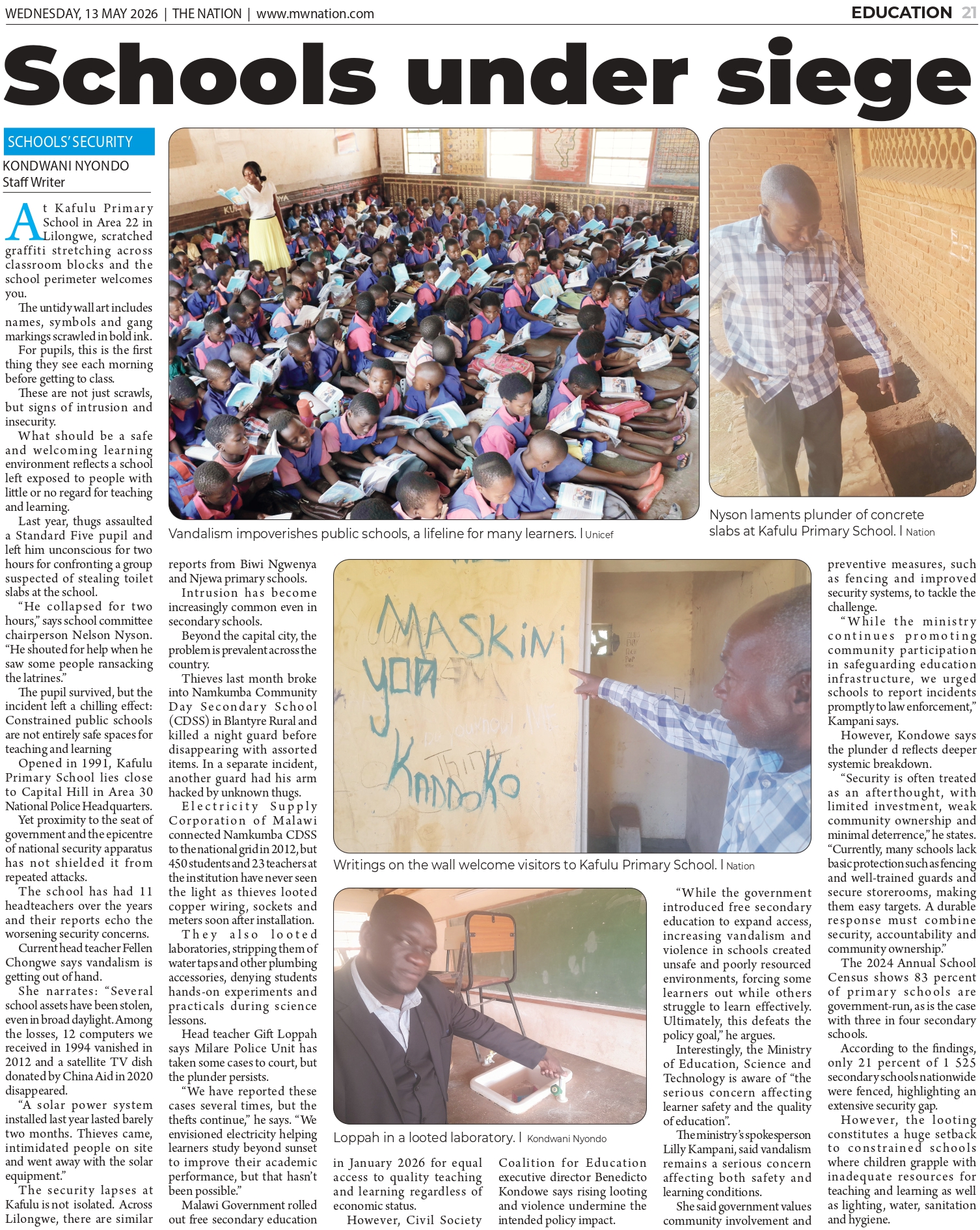
Across Malawi, schools are meant to represent opportunity, safety, and the promise of a better future. However, emerging reports paint a deeply concerning picture one where these spaces are increasingly vulnerable to vandalism, theft, and violence. What should be environments that nurture learning are, in some cases, becoming zones of insecurity and disruption.
Recent coverage by The Nation highlights the extent of the challenge. Schools such as Kafulu Primary in Lilongwe have experienced repeated incidents of vandalism, theft of essential infrastructure, and even violent attacks involving learners and security personnel. These are not isolated cases. Similar patterns are being reported across districts, affecting both primary and secondary schools.
The consequences of these security breaches go far beyond physical damage. When classrooms are defaced, when laboratory equipment is stolen, and when solar power systems are dismantled, the impact is directly felt in the quality of education. Learners are deprived of essential resources, teachers are forced to operate under difficult conditions, and the overall learning environment becomes compromised. In extreme cases, fear and insecurity discourage attendance and participation, ultimately affecting retention and performance.
This situation is particularly troubling in the context of Malawi’s efforts to expand access to education. Policies such as free secondary education, championed by the Ministry of Education Science and Technology Malawi, aim to ensure that every child has the opportunity to learn regardless of economic background. However, without adequate protection of school infrastructure, these gains risk being undermined. Increased access must be matched with increased investment in safety and sustainability.
Statistics further underscore the scale of the challenge. With only about 21 percent of secondary schools fenced nationwide, the majority remain exposed to intrusion and vandalism. This lack of basic protective infrastructure highlights a critical gap in education planning and resource allocation. Security, in many cases, has been treated as an afterthought rather than a core component of the education system.
Civil Society Education Coalition, believe that addressing this issue requires a holistic and coordinated approach. Strengthening school security is not solely the responsibility of government it demands active participation from communities, local leaders, and development partners. Schools must be seen as shared assets, deserving of collective protection and accountability.
Investments in infrastructure such as fencing, secure storage facilities, and trained security personnel are essential. Equally important is fostering a sense of ownership within communities, ensuring that schools are protected not just by physical barriers, but by social responsibility. Strengthening reporting mechanisms and ensuring swift accountability for acts of vandalism and theft will also serve as important deterrents.
Ultimately, safe learning environments are fundamental to achieving quality education. Without safety, access loses its meaning. Without protection, investments in education cannot yield their full impact.
Protecting schools is not just about safeguarding buildings it is about safeguarding futures. Malawi cannot afford to let its classrooms fall into neglect and insecurity. The time to act is now, with urgency, commitment, and a shared vision for a safer and stronger education system.
Leave a Reply