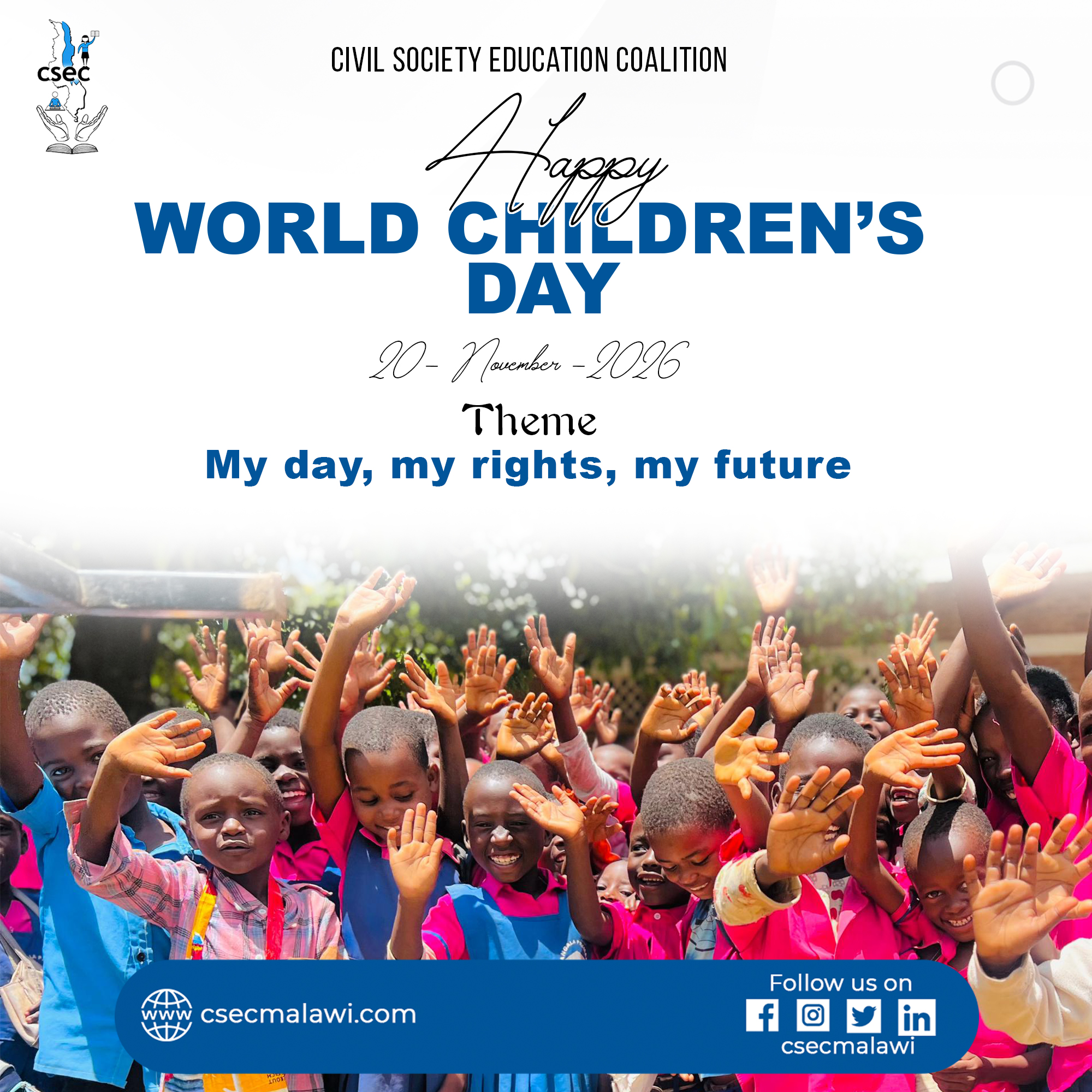
As the world commemorates World Children’s Day under the theme “My Day, My Rights, My Future”, Civil Society Education Coalition (CSEC) calls for renewed commitment to protecting children’s rights, strengthening their participation in decision-making and ensuring every child has access to quality, inclusive and equitable education.
Every child has a story, a voice and a vision of the future they want. Yet, too often, decisions that directly affect children’s lives are made without meaningfully involving them. From decisions about their education and safety to the environments in which they learn and grow, children’s perspectives remain underrepresented in conversations that should place them at the centre.
World Children’s Day, commemorated annually on 20 November, provides an important opportunity to reflect on children’s rights and renew collective responsibility towards building a world where every child can thrive. This year’s message, “My Day, My Rights, My Future,” reinforces a fundamental principle: children have the right to be heard, to express their views and to participate in decisions that affect their present and future.
Children’s rights cannot wait
Across the world, children continue to face challenges that threaten their rights, wellbeing and opportunities. Conflict, climate shocks, poverty and growing inequalities are disrupting childhoods, limiting access to essential services and placing additional barriers in the way of education.
These challenges are not distant realities for countries such as Malawi. For many children, access to quality education is still influenced by circumstances beyond their control, including poverty, disability, gender-based barriers, geographical location and the availability of adequate learning resources and supportive school environments.
Girls and children with disabilities, in particular, must be recognised in efforts to build an education system that responds to the needs of every learner. Access to education should never depend on a child’s ability, gender, background or circumstances.
Protecting children’s rights therefore requires more than commitments and policy statements. It demands sustained action, adequate investment, accountability and the active participation of children themselves.
Education must give every child a voice
Education is more than access to a classroom. It is about creating an environment where children feel safe, valued, respected and empowered to realise their potential.
Schools should be spaces where children can express themselves freely, participate in school activities, raise concerns and contribute to decisions concerning their learning experiences. Their views should inform how schools address challenges such as discrimination, violence, exclusion, inadequate learning environments and barriers to participation.
Meaningful child participation also requires adults to change how they engage with children. Listening should not be treated as a symbolic gesture or an activity reserved for special commemorations. It must become part of everyday practices in schools, families, communities and institutions responsible for shaping education policies.
When children are given opportunities to participate meaningfully, they help identify challenges that adults may overlook and contribute valuable perspectives towards solutions that affect their lives.
A shared responsibility to protect children’s futures
The responsibility to protect children’s rights does not rest with one institution. Government, development partners, civil society organisations, parents, teachers, school governing bodies and communities all have a role to play.
For Malawi, this means strengthening efforts towards inclusive and equitable quality education, ensuring that education policies translate into meaningful improvements in children’s lives and addressing the barriers that prevent some learners from participating fully in education.
It also means creating opportunities for children to engage in conversations about their education and wellbeing, strengthening child-friendly accountability mechanisms and ensuring that their concerns are heard and acted upon.
As a coalition committed to advocating for inclusive, equitable and quality education for all, the Civil Society Education Coalition (CSEC) recognises that children’s rights must remain at the centre of education advocacy. Every child, regardless of their ability, gender or circumstances, deserves an opportunity to learn, participate and contribute to society.
This commitment requires education stakeholders to move beyond simply speaking about children and begin creating spaces where children can speak for themselves.
The future we choose today
The decisions made today will influence the opportunities available to children tomorrow. Whether these decisions concern education financing, school infrastructure, teacher support, digital learning, child protection or inclusive education, their impact will ultimately be felt by children.
As we mark World Children’s Day, CSEC calls on all education stakeholders to renew their commitment to protecting children’s rights, listening to their voices and ensuring that their participation translates into meaningful action.
Children should not have to wait until they become adults to influence the future they will inherit. Their voices matter today. Their rights matter today. Their future begins today.
Let us choose a future where every child is heard, every right is protected and every learner has an equal opportunity to succeed.
My Day. My Rights. My Future. Let us choose a future for children.
Leave a Reply